Social Engineering Penetration Testing
Social engineering penetration testing exposes human-layer security gaps. Controlled phishing, vishing and physical attack simulations for UK organisations.
What Is Social Engineering Penetration Testing?
Social engineering penetration testing is a controlled security assessment that simulates manipulation-based attacks against employees to evaluate an organisation's human-layer defences. Where technical penetration testing probes firewalls, applications, and network configurations for exploitable flaws, this discipline targets the people who operate those systems, examining how staff respond when a caller, email, or visitor tries to talk, trick, or bluff their way past normal controls.
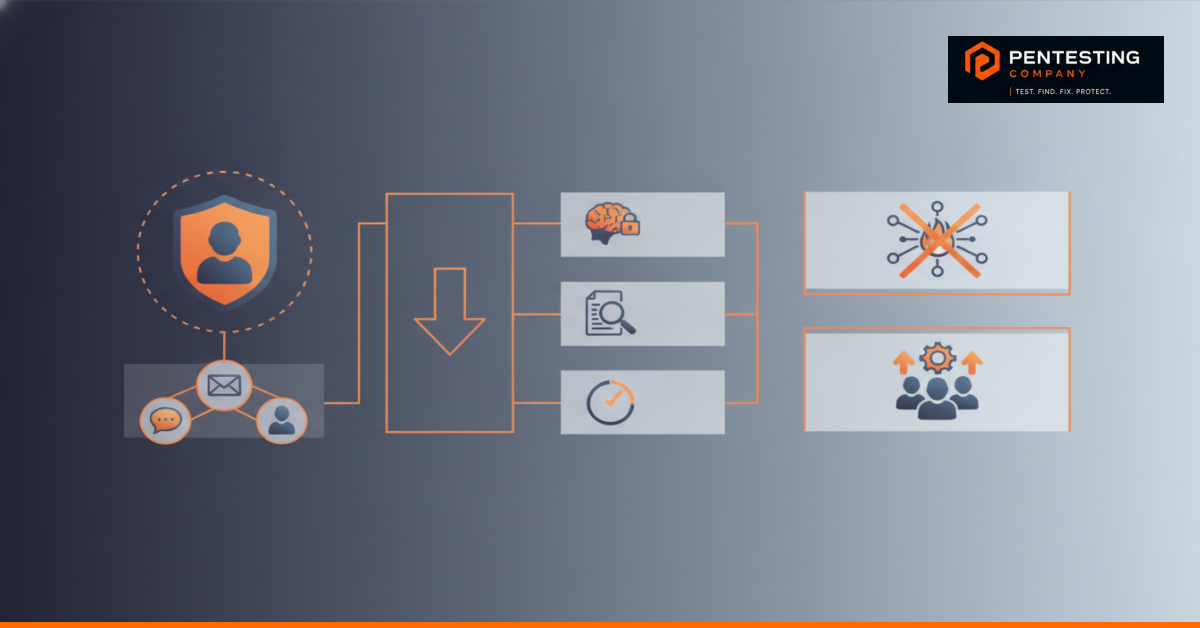
The test measures three things directly: how susceptible employees are to a manipulation attempt, whether they follow correct reporting behaviour when something feels wrong, and how quickly that reporting reaches the security or IT team. A network penetration testing engagement will tell you whether a server is patched. A social engineering test tells you whether the person with access to that server would hand over a password to a convincing phone caller.
Social engineering testing is often assumed to mean phishing email campaigns and nothing else. In practice it is a multi-vector discipline that can include phone-based attempts (vishing), text-based attempts (smishing), and physical onsite scenarios such as tailgating into a building or impersonating a visitor. Treating it as "just phishing" understates both the risk and the value of a properly scoped engagement.
Why Run a Social Engineering Penetration Test?
Human error is a material and recurring factor in security incidents across most organisations, regardless of how mature the technical estate is. A firewall cannot stop an employee from reading out a one-time passcode to someone claiming to be from IT support, which is precisely the gap this testing is built to expose.
A social engineering test produces something a technical assessment cannot: evidence of which individuals or teams are most susceptible to manipulation, how they behave under social pressure, and how fast suspicious contact gets reported rather than acted on. Attackers routinely bypass well-configured technical controls by going around them entirely, targeting a person rather than a system, because it is often the faster route in.
People are best understood as an addressable control surface rather than a "weakest link" to be written off. A control surface can be measured, tested, and improved with the same rigour applied to a network or application, which is the whole premise of running this type of engagement rather than relying on generic awareness posters.
This testing also supports audit readiness for information security frameworks and regulatory expectations, including the security obligations set out under GDPR, the human-factor controls referenced in ISO 27001 Annex A, and the awareness considerations built into Cyber Essentials. It does not replace a formal compliance audit, but it gives an organisation evidence that human-layer risk has been actively assessed rather than assumed.
Testing frequency matters more than testing volume. A single annual assessment establishes a baseline, but recurring campaigns that integrate with a training calendar are what produce measurable, sustained improvement in reporting behaviour and click resistance over time.
- Identifies which departments or roles carry the highest human-layer risk
- Provides evidence for stakeholders that security spend is addressing a real, measurable gap
- Supports audit and compliance conversations around GDPR, ISO 27001, and Cyber Essentials
- Complements network penetration testing by covering behavioural gaps rather than system flaws
- Builds a data trail to demonstrate improvement across successive test cycles
How We Run a Responsible Social Engineering Test
A responsible social engineering test is one governed by a written rules-of-engagement document agreed before any scenario runs. That document defines exactly what testers may attempt and, just as importantly, what is off-limits: no targeting of family members, no exploitation of personal or emotional crises, and no unauthorised access to confidential material outside the agreed scope.
Stakeholder alignment happens before testing starts, not after. HR and internal communications should be looped in early so that if an employee reacts strongly to a scenario, there is already an agreed line of support and explanation in place rather than a scramble to respond.
Results are reported at group or team level rather than as a list of named individuals who failed a specific scenario. Public shaming defeats the purpose of the exercise: an employee who fears blame is less likely to report a genuine suspicious email in future, which is the opposite of what the test is trying to achieve.
Any personal data used to build or run a simulation, such as staff email addresses or job titles gathered for a pretext, is handled in line with UK GDPR and data protection obligations, including how long that data is retained after the engagement closes.
An escalation protocol should exist for the rare case where a simulated attack overlaps with, or accidentally triggers, a real security event during the testing window. This is one of the most important buying criteria in the entire service and one that most buyers never ask about directly. A provider without a documented pause-and-assess procedure for exactly this scenario is not equipped to run a controlled test safely.
Staff are typically informed after the test, not before individual scenarios run, and the framing matters: results are presented as a learning programme with clear next steps, not as an audit of who failed.
Questions worth asking any provider before engagement:
- What does your rules-of-engagement document explicitly rule out?
- What is your documented escalation procedure if a simulation coincides with a real incident?
- How is staff-level data handled and retained after the test concludes?
Types of Social Engineering Attacks Covered
Social engineering attacks fall into two practical categories: digital vectors carried out remotely, and physical vectors carried out onsite. The four most commonly cited core categories are phishing, vishing, smishing, and pretexting, and a fuller engagement typically expands beyond these into a wider taxonomy depending on the organisation's risk profile.
Pretexting sits underneath most of these attack types rather than standing apart from them. It is the underlying technique of constructing a false narrative, such as posing as IT support, a supplier, or a new starter, that gives an attack its credibility before any request for information or access is made. A related technique, quid pro quo, involves offering a fake benefit, such as free IT support or a prize, in exchange for credentials or access, and is sometimes built into phishing or vishing scenarios as a variant rather than tested as a standalone vector.
| Digital vectors | Example scenario |
|---|---|
| Phishing (bulk email) | An email claiming to be from IT, requiring a password reset within 24 hours via a linked form. |
| Spear phishing (targeted email) | An email referencing a real project or colleague name to increase credibility for one department. |
| Whaling (executive phishing) | A message impersonating a supplier or board member, aimed at a senior finance contact. |
| Vishing (phone-based) | A call from "HR" or IT asking staff to verify bank details or reset a password over the phone. |
| Smishing (SMS-based) | A text message impersonating a delivery firm or internal system, prompting a link click. |
| Physical vectors | Example scenario |
|---|---|
| Tailgating / piggybacking | A tester follows a genuine employee through a secure door without swiping a pass. |
| Impersonation | A tester poses as a contractor or courier to gain access to a restricted area. |
| USB drop / baiting | A branded USB device is left in a communal area to see if an employee plugs it in. |
Phishing is the standard baseline included in most engagements, while vishing and physical testing are typically offered as optional additions once an organisation has run an initial email-based assessment.
The Engagement Process — What to Expect
A social engineering engagement runs through six defined stages from initial scoping to final report delivery, typically completing within 2 to 4 weeks depending on scope and the number of vectors included.
- Scoping and objectives. This stage sets which employees are in scope, how many scenarios will run, which vectors are included, and what success looks like against agreed metrics.
- Reconnaissance. Open-source intelligence gathering informs realistic scenario design, drawing only on publicly available information relevant to the agreed scope.
- Scenario design. Scenarios are tailored to the organisation's sector, internal language, and risk profile, built to be realistic without causing operational disruption such as forced account lockouts. This stage often benefits from structured scenario-based engagements to systematically test specific threat models.
- Execution. Simulated attacks run over a defined window, usually 1 to 2 weeks, scheduled to avoid peak business periods such as year-end close or a product launch.
- Monitoring and data collection. Click rates, report rates, and response behaviours are tracked throughout the execution window as they happen.
- Reporting and remediation. Findings are compiled into an executive report and delivered through a debrief with stakeholders.
What determines the size and effort of an engagement is worth understanding before requesting a quote.
| Scope driver | What it affects |
|---|---|
| Number of in-scope employees | Volume of simulations to design, send, and monitor |
| Number of attack scenarios | Breadth of the test and depth of comparative reporting |
| Attack vectors included (email, phone, physical) | Planning complexity and onsite logistics |
| Reporting depth required | Analysis time and level of departmental breakdown |
| Testing frequency | Whether this is a one-off assessment or a recurring programme |
The final report is the primary deliverable of the engagement. It typically covers:
- An executive summary written for non-technical stakeholders
- Headline metrics, including click-through rates and report rates
- A scenario-by-scenario breakdown of what was tested and how staff responded
- Root-cause commentary on why particular scenarios succeeded or failed
- A prioritised remediation plan and an agreed scope for retesting
Phishing Simulation vs. Full Social Engineering Assessment — Which Do You Need?
A phishing-only campaign is the right starting point for an organisation running its first social engineering exercise or building an awareness programme from scratch. A full multi-vector assessment adds vishing, smishing, and physical breach attempts, and suits organisations with an established awareness programme, a higher risk profile, or a specific compliance driver behind the engagement.
| Configuration | What it measures | Best suited to |
|---|---|---|
| Phishing simulation | Email susceptibility, click rates, report rates | First-time buyers, early-stage awareness programmes |
| Full social engineering assessment | Email, phone, SMS, and physical response, plus deeper scenario realism | Mature security programmes, higher-risk sectors, compliance-driven testing |
Social engineering sits as one discipline within a broader red team engagements approach rather than a standalone product tier, and organisations that have never run a phishing baseline should not start with a full multi-vector assessment. The realistic route is phased: establish a phishing baseline first, then layer in vishing and physical testing once staff awareness has had time to mature and the organisation is ready to act on the additional findings.
What Social Engineering Penetration Testing Cannot Do
A social engineering test measures behaviour during a defined window under a specific set of scenarios, and it has clear limits that a reputable provider should explain upfront rather than gloss over.
- It is a point-in-time snapshot, not a permanent verdict on the organisation's security culture.
- Results depend heavily on scenario realism: an overly aggressive scenario can inflate failure rates, while a generic one can understate real risk.
- A clean result does not guarantee employees will never fall for a genuine attack outside the test window.
- It should never be the only security measure in place; technical controls such as two-factor authentication, monitoring, and ongoing training remain essential alongside it.
- Scenarios must reflect operational context; an approach that works for a small office may be genuinely disruptive for a busy customer-facing call centre.
These limitations are a reason to build a layered security programme around the test, not a reason to skip it. Honest scoping of what the test can and cannot prove is what separates a useful engagement from a box-ticking exercise.
Building Security Awareness After the Test
A social engineering test delivers its full value through a Test, Train, Retest cycle rather than as a single report handed over and filed away. Findings identify where susceptibility is highest, targeted training addresses that specific gap, and a follow-up assessment confirms whether behaviour has actually changed.
Report findings map directly onto training content: a department with a high click rate on a phishing scenario receives a focused awareness session on that vector, while individuals who click repeatedly across campaigns receive more direct refresher training rather than generic company-wide messaging.
The click rate is only half the picture. The report rate, how many employees flagged the simulation as suspicious, is the metric that reflects whether a reporting culture is actually working, and a high report rate alongside some clicks is still a positive outcome worth recognising rather than dismissing.
A retest within 6 to 12 months gives a measurable comparison point against the original baseline, showing whether click rates have fallen and report rates have risen. HR and communications stakeholders should be part of the post-test debrief so findings are used constructively, feeding into security awareness training content rather than being treated as a one-off audit result.
- Click rate: the percentage of targeted employees who interacted with a simulated attack
- Report rate: the percentage who flagged the attempt as suspicious through the correct channel
- Time to report: how quickly a suspicious contact was escalated once noticed
- Repeat susceptibility: whether the same individuals fall for multiple scenario types across a campaign
How to Choose a Social Engineering Testing Provider
A capable provider will answer the following questions clearly and specifically, without deflecting to generic marketing language.
- How do you handle informed consent and stakeholder alignment before the test?
- What does your rules-of-engagement document cover, and which attack types are off-limits?
- How is personal data handled during simulated campaigns, and is this GDPR compliant?
- What does your reporting deliverable include, and do you offer a debrief with stakeholders?
- Do you offer retesting, and how is improvement measured between assessments?
- What is your escalation protocol if a real incident occurs during the simulation window?
- How is staff communication handled post-test to protect morale?
- What experience do you have testing organisations of a similar size or sector to ours?
The escalation protocol question is the one most buyers never think to ask, yet it says more about a provider's operational maturity than almost anything else on this list. A provider without a documented answer is not one to trust with a live simulation inside your organisation.
We work with UK-based organisations from our London base to scope and deliver social engineering assessments that fit your risk profile and existing awareness programme. Get in touch to discuss scoping and receive a tailored quote.
Frequently Asked Questions
What is social engineering penetration testing?
It is a controlled assessment that simulates manipulation-based attacks, such as phishing, vishing, and physical impersonation, against employees to test how well an organisation's people identify and report suspicious contact.
How much does social engineering penetration testing cost?
Cost depends on the number of employees in scope, the attack vectors included, the number of scenarios, and reporting depth required. Get in touch with your scope details for a tailored quote.
How long does a social engineering penetration test take?
Most engagements run from scoping to final report delivery in 2 to 4 weeks, with the active simulation window typically lasting 1 to 2 weeks depending on scope.
Is social engineering testing ethical?
Yes, when it is run under a clear rules-of-engagement document, with informed stakeholder alignment beforehand and group-level rather than individual-blame reporting afterwards. Providers should also have a documented escalation protocol for real incidents during testing.
What is the difference between social engineering testing and phishing simulation?
Phishing simulation tests one vector: email susceptibility and reporting behaviour. A full social engineering assessment expands this to include vishing, smishing, and physical vectors such as tailgating or impersonation.
How do you prepare staff before a social engineering test?
Individual employees are not warned about specific scenarios, as this would undermine the test. Instead, HR and communications stakeholders are aligned in advance so that results, once shared, are framed as a learning exercise rather than a surprise audit.
Ready to scope your social engineering test?
We work with UK-based organisations from our London base to scope and deliver social engineering assessments that fit your risk profile and existing awareness programme. Get in touch to discuss scoping and receive a tailored quote.